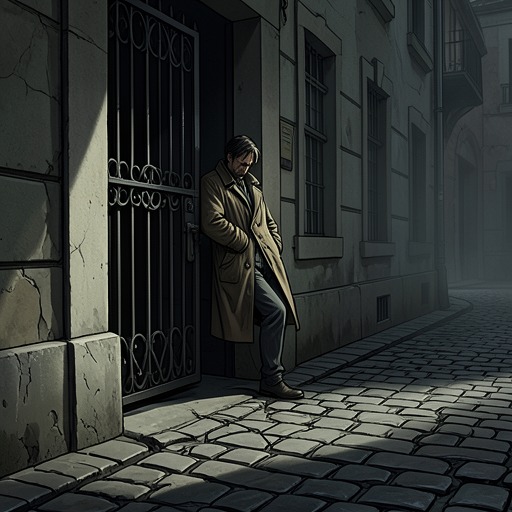
The burned Fortuny family photograph
The Shadow of the WindThe burned Fortuny family photograph is a damaged studio portrait that connects Julian Carax to the Fortuny family and shop, and becomes one of the material clues through which Daniel Sempere reconstructs Carax’s past. Its surviving image offers a tender glimpse of Carax as a young man; its later circulation among witnesses and its contrast with manipulated official records make the photograph more than a likeness: it is a fragile counter-record of identity.
Appearance and Identification
The photograph appears unexpectedly in the bookshop after Daniel hears footsteps, a stifled laugh, and books falling from shelves. When he goes to investigate, the shop is empty, but the photograph has been left on the counter. It is an old studio portrait printed on thick cardboard, its edges burned and its image marked by what Daniel perceives as charcoal fingerprints. The damaged object seems to have arrived from an unseen visitor, though the scene does not establish who left it.
The portrait shows a young couple standing close together. The man, perhaps seventeen or eighteen, has light hair and delicate, aristocratic features; the woman is at most a little younger, with pale skin, a finely shaped face, and short black hair. His arm is around her waist, and she appears to be whispering to him playfully. Their expressions and closeness give the surviving image an air of warmth and hope. Behind them, an ornate shop window displays old-fashioned hats, while a stern face can still be made out behind the counter. The lettering identifies the establishment as Sons of Antonio Fortuny, established in 1888.
Daniel estimates that the photograph is at least twenty-five or thirty years old. He recognizes the young man as Carax after learning from Isaac that Carax used his mother’s surname rather than his father’s, Fortuny, and that his father owned a hat shop on Ronda de San Antonio. The photograph thus brings together a face, a family name, and a place of business: details that had been separated in the accounts Daniel was trying to piece together.
A Private Image Tested Against Memory
Daniel later shows the burned photograph to the caretaker who had known Carax. She studies it suspiciously and confirms that the young man is Julian. Her recollection offers a small qualification: Carax had been very fair, while his hair in the picture appears darker. The image is therefore not a self-sufficient proof. Its identification gains strength through comparison with a witness’s memory, even as that memory draws attention to a discrepancy.
That exchange also reveals the photograph’s unusual function in the inquiry. It does not merely illustrate a name Daniel already knows; it gives him something he can put before another person and ask her to recognize. The caretaker’s confirmation links the pictured youth to the adult remembered as Carax, while her reservation preserves the limits of visual evidence. The photograph makes recognition possible without eliminating uncertainty.
Photograph and Documentary Evidence
Elsewhere, the story’s official records present a sharply different kind of identification. A body delivered to the morgue in September 1936 carried a book and a passport naming the dead man Julian Fortuny Carax, born in Barcelona in 1900. The passport’s border stamp indicated that Carax had returned to Spain about a month earlier; the body was identified by Fortuny, and a gunshot wound was recorded as the apparent cause of death. Yet the morgue account later reveals that an unnamed third policeman overrode procedure, took the passport, ordered the body sent to Montjuic for burial in a common grave, and signed the registration as though his assertion settled the identity.
The novel eventually explains that the apparent confirmation of Carax’s death was built on a substitution. Miquel Moliner had been killed, and his body was left in the Raval with a damaged passport in Carax’s name and a copy of The Shadow of the Wind. The police registered the corpse as Carax; Francisco Javier Fumero recognized Miquel but signed the report confirming the false identity. The photograph and the official paperwork therefore occupy opposing positions in the book’s chain of evidence. The photograph preserves a recognizable face and its connection to the Fortuny shop; the passport and death registration are made to support a deliberately false account.
The Object as a Counter-Archive
The photograph’s physical damage matters to its meaning without making it an authoritative record of everything it depicts. Fire has consumed much of the image’s surroundings, but it has not erased the young couple, the shop sign, or the figure behind the counter. What survives is partial: a likeness, a business name, and a trace of the scene in which Carax belonged to a family and a place. Its incompleteness makes it a clue to be interpreted rather than a complete explanation.
Its passage through Daniel’s hands and into a witness’s scrutiny contrasts with the state’s power to alter a dead person’s public identity. A small private image can prompt recognition, while an official form can impose a false name and send a body to an anonymous grave. The photograph does not by itself undo that falsification, but it belongs to the alternative record Daniel assembles from objects, memories, and testimony. Its survival keeps a human image of Carax in view where the paperwork has obscured the truth.